
Bugs, Plagues and Pestilence was a fascinating and highly entertaining talk by Dr John Reuther on the role that bacteria and viruses have played in determining the outcomes of significant events in history, particularly when looking at military campaigns.
Dr Reuther, a microbiologist, began his talk by defining the difference between viruses and bacteria and looking at the conditions necessary for them to spread successfully which depends on close contact with people and/or animals. Exploration of ancient burial sites show evidence in teeth for the diseases people suffered as traces of bacteria are able to be detected in dental pulp many centuries after death.
Starting with the hunter gatherers of pre-history he said that when humans lived in small communities diseases were virtually unknown. He pointed out that the life expectancy of a pre-history hunter gatherer was 35. But we have not progressed much beyond that today as our immune system starts to fail by the time we get to our 40s and are not geared up to help us survive into our 70s and beyond. Dr Reuther suggested that although the life expectancy of a hunter gatherer was only 35 years it was not as a result of any disease but because they were more likely to be preyed on by animals or to die from accidents.
Once people started to increase in numbers and live in close proximity with livestock and each other, water sources became polluted and viruses and bacteria were able to advance. This, combined with the highly evolved tendency of bacteria to mutate in order to transfer between species, allowed diseases to develop. The first recorded epidemic was a consequence of the eruption of Santorini (1646 BC).
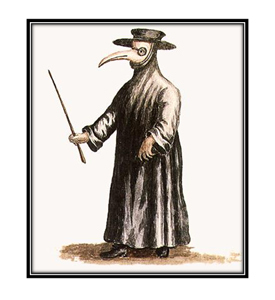
Dr Reuther then looked at the lack of immunity of some ethnic groups to several diseases and the effect these had on the growth and collapse of Empires throughout history. He said that the part these small organisms played in deciding historical events are greatly overlooked by many historians. Starting with the fall of Athens, in the Spartan wars, he moved on to the rise and fall of Rome and the demise of Constantinople. He considered the impact of the Black Death on the restructuring of English society. The death rate in the 13th century was so high that it is thought that over a third of the population died which is considered to have caused the demise of the feudal system. Moving on to the Napoleonic Wars Dr Reuther suggested that although Napoleon had invaded Russia it was the effects of typhus on the troops that prevented the French from holding on to their conquest.
After a brief description of the 'flu pandemic that ended WW1 Dr Reuther concluded his talk by stating that a new microbiological disease emerges roughly every 10 years.
In the course of the evening, Dr Reuther managed to completely rewrite the A level history course I took all those years ago, which just goes to show how much more we can understand now with the development of scientific research.
This was a fascinating and highly entertaining talk from a knowledgeable and experienced speaker, looking at some major events in history from another aspect, annd was well received by members.
Report by Viv Carter