
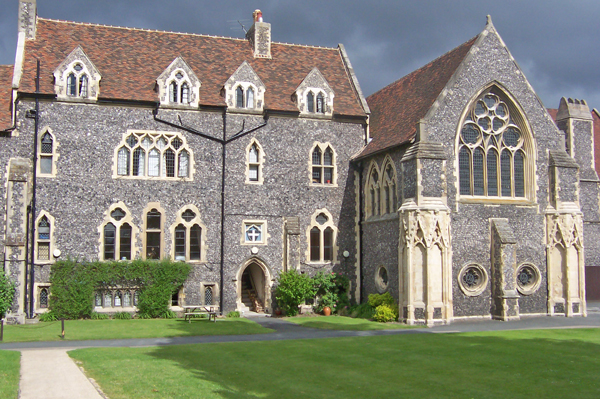
St Augustine's Abbey Canterbury
The ever popular, Local Historian and Genealogist, Peter Ewart, Vice President of KFHS was the first speaker at our return to the newly rebuilt British Red Cross Centre, Chantry Lane, Canterbury.
Peter's talk Bridging Two Worlds: from Zululand to Canterbury & Back, was a historical talk seasoned with a large pinch of local history. He started with slides of a South African hill which looks from some angles like a crouching lion. It is in the area known as Isandlwana and is now visited by thousands of people. The reason for their interest became apparent as he sketched out the events of January 1879 when the British were overwhelmed by the Zulu nation winning the day in the last ditch stand, at Rorke’s Drift. Peter jokingly referred to the ‘help’ that Michael Caine, Stanley Baker & co had given; a reference to the iconic and slightly jingoistic 1964 film of the event.
The Anglican Church missionaries had already set up a mission station in the area which is in the Diocese of Zululand. Called St Augustine’s it continued its mission after the wars including providing a school for Zulu boys. Bishop Douglas Mackenzie was in charge and allowed boys to come as they could as they had to work to help their families. The plan was to pick out boys who showed academic flair to be sent to England in the hopes they could be educated as teacher missionaries to return to minister to their people. Several intelligent students were already in the scheme when, Gregory N'gcobo, was spotted as an outstanding scholar. Bishop Mackenzie died whilst planning Gregory’s higher education but eventually the bishop’s widow, who was returning home to England, agreed to stand as Gregory’s guardian and escort him to school.
The fourteen year old Gregory arrived at St John’s College, Hurstpierpoint, Sussex in 1891. Peter showed slides of the building and students during Gregory’s time there but said unfortunately none were found of him. St John’s was a public school with a mix of students from different social spheres but Gregory was the only black African. In later years when some of his contemporaries wrote life histories they remarked that at the time they had not thought about Gregory's skin colour. He was accepted for himself with no racial issues. The only difference being he was known as 'Gregory' due to his Zulu surname, N'gcobo, having an almost unpronounceable click.
During the holidays Gregory stayed with headmaster Christopher Smyth’s father in Gloucestershire. He helped him become an ‘English Gentleman’. The English language was a challenge but Gregory mastered it.He also did well at sport and loved cricket, possibly more than academic subjects!
Mrs Mackenzie returned to Zululand where she continued to fund his education and receive his reports. In 1895 she received a letter from Gregory saying he was homesick having been away from his homeland for 4 years. Being told he must stay a little longer to study at St Augustine’s Mission College spurred Gregory to ask to be fast tracked. After much discussion, many letters of praise, and the backing of his Chaplain, it was agreed.
In September 1895 Gregory arrived in Canterbury where he was probably the only black face in the city. Peter showed slides of St Augustine’s in that period describing the buildings, their uses and pointing out the student accommodation newly built in which today’s King School boys now lodge. Students were taught carpentry, building, bookbinding and medical subjects that would be needed when they returned to South Africa alongside languages and other academic subjects. Gregory was particularly outstanding in the Classics; his Greek and Latin surpassed students who had studied twice as long as he had. Gregory especially enjoyed the weekly sport afternoon and slides of him were shown in the football and cricket teams which the College fielded. Peter said he would love to find evidence that his Grandfather had played against Gregory. Cricket was still unknown in South Africa and it was remarkable that Gregory reached such a good standard making newspaper headlines in 1895 as the best ‘black Englishman’ to play the game.
After 3 years in Canterbury Gregory applied to sit his final exams early and was rewarded by passing ‘with flying colours’, being the first Zulu to do so. After being away for 6 years he finally returned to Zululand finding it very different to when he had left and he had changed so much in appearance that even his own mother didn't recognise him!
By 1903 Gregory was failing with his teaching and was sent to Portuguese East Africa, where he received help and support, and where he was finally ordained as a priest. Returning to Zululand he married a Zulu girl and they had 3 children. As ‘black’ priests were only allowed to perform marriage ceremonies for black people he travelled around the country to do this. He kept in touch with acquaintances in Canterbury and wrote to friends saying how much he missed his life with them and asked to be sent copies of the numerous photos of him taken during his time there.
He died aged aged 56, in 1931, when a lorry he was travelling in was involved in an accident. His son wrote to St Augustine’s College to tell them the news which was reported, as for all ex-students, in the college journal.
There is no memorial to Gregory either for his time at Hurstpierpoint, or Gloucestershire where he stayed in his holidays. But in St Augustine’s Peter managed to find an inscription, almost hidden by pipes, on a wall in the College Chapel. Peter said he would love to find Gregory’s descendants. He thinks they probably have no idea that Gregory was so successful in bridging two worlds!
To celebrate the first meeting of 2013 in our new location the evening ended with refreshments and appetising snacks kindly provided by Sheila and Daphne Pearson.
Report by Tricia Baxter