
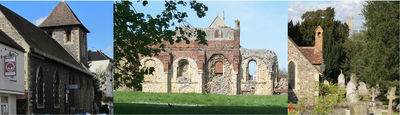
The parish of St Martin and St Paul Canterbury has so much history in less than a mile. Below this report is a Gallery of images taken on the day.
We were joined by Annette a KFHS member from New Zealand who was visiting Canterbury for a few days. The group met at Lady Wootton’s Green, named after a 17th century resident, and followed the route that Queen Bertha took to her church dedicated to St Martin of Tours. In 1988 St Martin’s was recognised by UNESCO as the oldest church in the English speaking world. The Saxon Queningate which Bertha used was originally built during the Roman occupation. Now blocked up its outline can still be made out in the city wall near to the current Queningate.
We met Peter Henderson, Archivist and Walpole Librarian of The King’s School, at the Findon Gate built in 1309 by the Abbot of that name. Peter gave us a tour behind the gate which was once part of the Abbey and has a very diverse history from Royal Palace to Brewery, private house to Missionary College and various other incarnations along the way to becoming part of The King’s School. In the 17th century when it was a private house the gardens were laid out by John Tradescant the Elder, later gardener to Charles I. We visited the Missionary College chapel which is covered in Monumental Inscriptions to Deacons and Priests who trained at the college and died in the course of their work in far flung places in the world.
Our next port of call was to the church of St Paul that has been united with St Martin’s since 1681. Passing by Cemetery Gate built by Abbot Ickam in 1399 (now called Bailey House) which once led to St Paul’s church burial ground until the Reformation. Thence into Longport and standing on the corner by Hales water pump Tricia talked about the water from the springs on St Martin’s Hill that once provided the city with potable water.
At St Augustine’s Abbey we were met by Georgia Morton-Brown who gave us an enlightening tour of the Abbey ruins. Being an extremely hot day we made use of chairs, shade, cold drinks and ice lollies outside the Abbey Museum and reception centre. Tricia then talked about the first Kent & Canterbury hospital that in 1937 became a girls and then, when the girls Tech moved to Barton Court, a boys Technical School. This building stood on the site where we werenow sitting from the 18th century to the 20th. Also nearby was the factory that father and son Pharmacist’s, Edwin and Charles Bing, made their efficacious Lavender and Lemon drink using water from the spring that once fed the Abbey.
Passing St Paul’s post reformation graveyard, now redundant, we stopped at the Old Sessions House. Here our Chairman David Wood told us about the significance of the Fasces, as a symbol of justice, on the railings and above the doorway. Then on to the House of Correction a first in Prison buildings built by Jeremy Bentham. The design was based on George Byfield's radiating Inspection House, where one Warder could see all cells from a central point. The original art of the prison is a listed building. Both Sessions House and Prison are now part of Christchurch University with the non listed part of the Prison currently being made into student accommodation.
Opposite the prison almost obscured by trees is Barton Court now a school. A Manor House from the Reformation it was originally the home farm (Barton being an ancient word for farm) for the Abbey. It still retains the medieval fishpond, but minus the fish! The lands of the Abbey and later Park and farm of the Manor stretching some 450 acres to the south and are still referred to by locals as Barton Fields. In WWI Barton Court saw service as a VAD hospital run by 6 of the 7 Russell daughters whose home it was at that time. In WWII the Manor was again used as a hospital, an ambulance station and a school; whilst troops camped in the Park. Much of this area of Canterbury was bombed in the Baedeker Raids of 1942 but Barton Court narrowly missed being hit.
Next to Barton Court are the Smith Alms Houses which were built in 1657 on land belonging to the then owners of Barton Manor: John and Ann Smith. They founded the charity to give thanks for the birth of a son after 20 plus years of childless marriage.
Arriving at St Martin’s Church we had a talk by Tricia about the history of the church: the chancel of the church was built during the Roman occupation and the Nave by the monks of the 597 Mission led by Augustine.
Tricia finished the Walk at St Martin’s Church but a few hardy souls were interested in seeing the remains of Conduit House which sheltered the Spring that once served the Abbey. Conduit House is off the path that the Monks of Augustine’s used to walk to Fordwich an ancient way that can still be used today.
Next Meeting
Friday 10th August 2018 'Barking up the wrong tree' by John Titford