
Before the start of the evenings proceedings a minute’s silence was observed in remembrance of the passing of H.M. Queen Elizabeth II (1926 – 2022).
The branch then congratulated David Wood on becoming Vice President of the Society. This is in the gift of the Executive Committee in recognition of his service, in various categories over the past 20 years, including Chairman on both the KFHS Executive Committee and at branch level. Branch members were pleased to know that although David is standing down from the Executive Committee he will be continuing as Canterbury Branch Chairman.
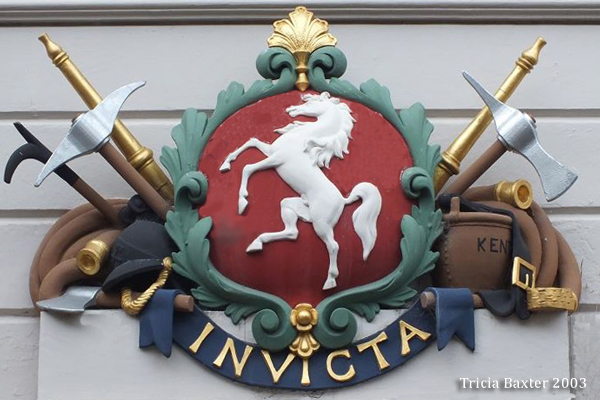 Talk: ‘A history of fire fighting in Kent’ with Howard Meyers - This evening’s speaker, was a former career fire fighter who spent his Fire Brigade service in Kent and London. He is now heavily involved with the Kent Firefighting Museum at Ash near Sevenoaks as both the Treasurer and a Trustee.
Howard’s illustrated talk started with the question What is Fire? Friendly or unfriendly? Promptly moving on to our earliest ancestor’s involvement with fire. He said that excavations in Fordwich, in 1920, showed evidence of fire being used by humans in Kent some 620,000 years ago. However, their homes were highly flammable being made of wood and grass, plus they had to contend with the threat of lightening and forest fires. But how they guarded themselves against fire we can only assume.
Howard said that the true start of fire fighting in Kent can be dated to the Roman invasion of Britain in 43AD. The Romans brought with them Vigilis who were early firefighters. The Vigilis had been formed after a huge fire, in 6AD, destroyed a quarter of the buildings in central Rome. They had basic firefighting skills and equipment; such as leather buckets, plus chains and hooks to pull down buildings. The Roman Ctesbius developed a pump that helped to get water to the seat of a fire more effectively. A later invention was the Archimedes Screw, which was able to raise a greater amount of water from sources such as a lake or river. They also used a primitive chemical method of dousing a fire with wine that had turned into vinegar.
There is little evidence that we adopted Roman ways to tackle fire after they left these islands. Hence one of the earliest fire safety laws recorded in England was introduced by the Normans circa 1068. This law required every household and business to extinguish all flames before going to bed. A Watchman cried at the 8 o’clock bell, couvre feu (cover fire) a term which has come down to us today as Curfew.
In 1301 the citizens of Sandwich were required to have a bath of water at their door and those that did not were fined. Whilst in 1591 Maidstone Burghmote introduced legislation for citizens to have buckets, chains and other fire fighting equipment to hand. An Act of Parliament in 1556 introduced patrolmen to walk the streets of London each evening ringing a bell with a cry that started: “Take care of your candle ...”. At this time, Blacksmiths forges were usually sited at the end of a village, due to the high risk of fire and by 1702 many Kent villages had some form of firefighting unit.
Howard showed illustrations of a 17th century wooden water main. These were made by hollowing out logs and shaping the ends to connect together. Trunks had holes drilled into them at various intervals with a wooden plug to enable access to water in the event of a fire. You may still see FP for Fire Plug on street furniture today although, H for Hydrant is more common.
Other illustrations shown were of early leather hoses which were very heavy to convey to a fire and we were shown a photograph of John Whitfield’s 17th century fire cart* built to carry fire equipment. A Whitfield fire cart was given to Canterbury Cathedral and has since been donated to the Museum.
The Great Fire of London (1666) saw the turning point in firefighting, as it led to the introduction of fire brigades by insurance companies. If a building was insured it would carry the insurance company's fire mark and only that insurance company's fire brigade would respond to the fire. Today fire marks are collectors’ items although many an old building's facade still carry a fire mark today. Thankfully, nowadays in the event of a fire, house owners no longer have to rely on the appropriate insurance company’s brigade turning up!
The first volunteer fire brigade in the county was formed about 1802 by the Hythe Fire Engine Association. Howard showed images of the engine and said that the Minutes of the Hythe Fire Brigade are archived at the Kent Fire Museum.
Howard talked us through key dates and innovations brought about by men such as James Braidwood (1800-1861) followed by Captain Sir Eyre Massey Shaw (1828-1908). Howard said that the latter has gone down in history as the ‘Captain Shaw’ in the Gilbert and Sullivan operetta Iolanthe. He also talked us through the development of the fireman’s helmet and that brass helmets had to be replaced when electricity was brought in. We were shown a photo of a damaged helmet that had melted when exposed to electricity.
Coming on to more modern times World War II triggered the introduction of a National Fire Brigade in 1948 but protective apparatus for Firemen was still quite rudimentary until the 1970s.
The development of fire engines can be seen at the Kent Firefighting Museum which houses engines from the horse drawn era, through steam and petrol to the diesel engines of today.
*Those members who came on Canterbury Branch’s July Walk will recall the Memorial to John Whitfield, an amateur inventor and a wealthy benefactor, in the Tower of the former church of St Mary Magdalene in the Burgate.
Report by - Tricia Baxter