
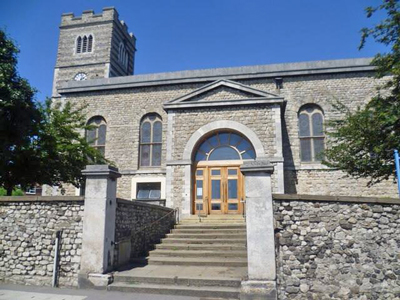
Access to Swaine Vestry is
at the back of the church
The group met to discuss any interesting features of our research regarding the occupations of our ancestors. It was a chance to share our findings and pool our knowledge of relevant sources for further research.
One member had a history of blacksmiths. There were at least 10 in one branch of her tree. This led to discussion about the role of the blacksmith and the lines of work they moved into once there was less need for their traditional role.
Another group member had looked at the statistical side of the occupations in her tree. Maybe unsurprisingly, there were far more occupations attributed to male family members than females (except for ‘Unpaid Domestic Duties’ of course!) Her tree contained mainly agricultural labourers and other jobs linked to food production along with a sizable number of dockyard workers. On the female side, the small number of occupations recorded were mainly linked to domestic service and clothing production.
One group member told of her research into her 4x great grandfather. Her research uncovered a man who started working on coal boats and moved on to travel to the West Indies as part of the spice trade. This led to her questioning whether he was involved in the slave trade. Although much had been discovered about him, there was so much that remained hidden.
The paternal line of one group member was heavily associated with the Royal Marines. On his maternal side, a grandfather was a lighterman on the Thames. This provoked discussion of the role of lightermen and sources of further information about them.
Another group member had two distinct sides to the occupations on her family tree. On her father’s side, her grandfather had been an engraver/ printer who worked in Fleet Street. According to the family, he made templates for putting the lettering on books. Two generations of men before him had been bookbinders. Her mother’s side of the family were from Wiltshire where occupations were almost all recorded as agricultural labourers, apart from one postman who worked for the Post Office his whole life.
A final group member had discovered three unusual-sounding occupations in her family tree: a boot clicker, a ships caulker and a coal whipper. A boot clicker was a skilled craftsman who cut out the upper parts of shoes. The name derives from the sound made as the knife touched the metal templates. A ships caulker was responsible for filling the gaps between the planks of a ship to ensure it was watertight. Finally, coal whipping was a physical and potentially dangerous job involving pulling up coal from the hold of ships, using ropes and pulleys.
Report by Helen Stenhouse