
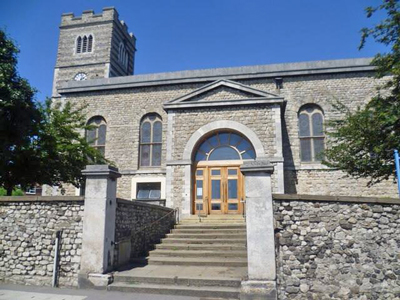
Access to Swaine Vestry is
at the back of the church
The group met on a hot sunny afternoon to share what we know about education in our family history.
One group member reported on her brother, who was the first in the family to go to university. He attended Sir Joseph Williamson Mathematical School before studying at London University and attaining a degree at another University. He then worked in Wales for a time before becoming a lecturer at Huddersfield University until his retirement about 5 years ago.
Another member told of her father who had left school in Hackney at the age of 11 but still managed to get himself a good job. Her mother had written down her memories of attending a small private school with only about 20 pupils. This was followed by a larger school, just for girls, which it cost one penny per week to attend. She left at the age of 14. An aunt, who had also recorded her memories of school days recalled attending assembly at the start of each school day, praying and singing hymns. It was only in later life that she had realised that the words that she had been singing to some of the hymns were actually incorrect, which explained why they hadn’t made any sense to her at the time!
The same group member recalled the beautiful handwriting of her husband’s grandfather, learnt at a school in London. The school is still in existence today, although it has been renamed due to an unfortunate link to someone who had made money in the slave trade.
One group member reported that their mother had attended a tiny school in North Cray. The school consisted of two room: one for infants and one for juniors.
Another report was about a father who became the first in the family to have more than an elementary education. He left school aged 14 and started an apprenticeship as a sheet metal worker. By 1939, he was considered a skilled worker and volunteered for the RAF. After 6 weeks initial training in Blackpool, he moved to RAF Weeton for 6 months. Here he studied both maths and calculus before being sent to a base in Wiltshire, and joining a maintenance unit patching up planes. According to entries in his diary, he studied further before gaining a degree in Maths and Aircraft Design at Bristol University.
One group member told of a 4x great grandfather who had been a cabman living in a stable where Harrods is located. He had two sons, one of whom was killed in an accident but the other had a beautiful signature on a document. Where he had received his education remains a mystery to our group member. This ancestor went to marry and have two sons of his own. The first went into the Army and on one document is written “In possession of 1st Class Education Certificate”. Again, where this was gained remains a mystery.
A new group member’s father attended school in Lambeth. His main memory was scrumping for apples in the grounds of Lambeth Palace. At the age of 15 he was scouted to play for Spurs but was prevented from taking that any further by his step-mother. Instead, he joined the RAF and travelled to Germany and Aden. After time working in Saudi Arabia to fund the money needed to purchase a house, he became a welder. This member’s mother attended school in Sevenoaks where she was encouraged to go to university. Her family were not willing for that to happen, so she became a telephonist for the GPO instead, which is how she met her future husband. The chaps in the RAF would call the telephonists and chat them up!
We heard about a grandmother who was a driver in the ATS in London. She worked out of a garage in Victoria and reported that she had a great time there, especially when the Americans arrived. She went on to drive for the police and had a very good career.
One group member told of distant ancestors who had attended Cambridge University back in the 16th Century before the family fortunes had changed. More recent family, such as our member’s parents, attended local schools to their home area.
A final group member reported that she had believed that she was the first in her family to attend university, before discovering that an ancestor who, despite coming from a long line of ‘ag labs’ had been sponsored by a local vicar to study theology and went on to found churches in New Zealand.
Report by Helen Stenhouse