
A recording of this talk was broadcast on Wednesday 7th January 2026.
A Handout for this talk is in the 'Kent FHS Event Handout Archive'
under KFHS Resources in the Members Area
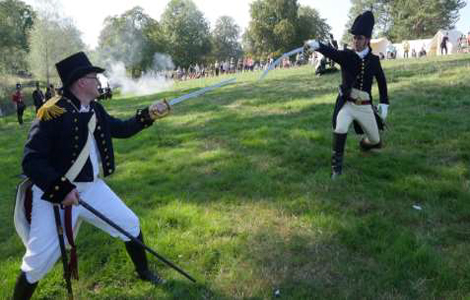
Our speaker, Stephen Summerfield, said his main interests were artillery, and being a chemist, also gunpowder, paint and metallurgy. He is also a battle re-enactor and showed photos of himself dressed as a Royal Engineer having a duel with an opponent dressed as a French Officer. He went on to give his information packed talk on the Defence of Kent through the ages; with emphasis on the Napoleonic War era.
Stephen started by saying that the Napoleonic period really includes the French Revolutionary Wars as in this period we were fighting the French continuously from 1792 through to 1815. Although, throughout history we were forever fighting the French and the population of Kent spent a lot of time worrying about the French and especially a French invasion.
Stephen than posed a rhetorical question, “How to defend Kent?” To which he replied, “Well basically don’t let them land!” To help us prevent landing we are aided by the natural coastal defences of geography, currents and winds, plus we have excellent ‘wooden walls’, that is a strong Royal Navy. And, most important, is to fight in Belgium and The Netherlands. Wars going back a thousand years have not been fought on English soil but on the continent.
Stephen said the plans for the defence of Kent for over a thousand years are very similar. The foreign armies were large, whereas we didn’t have a big enough army. So we stationed our troops along the southern coast, with the Chatham lines to fall back on. One of the plans involved flooding the low lying Romney Marshes. This was still the plan in 1756, 1790s and interestingly things don’t change much as it was even considered in the 1940s. Of course there would have been significant opposition from the local farming community who would have been left with land unviable for farming for at least 30 years after it had been swamped with seawater!
Stephen showed a slide of the Kent Cinque Ports of Sandwich, Dover, Hythe and New Romney plus Hastings in Sussex, long-established defenders of the coast. But by the 18th century all had suffered from silting up except Dover and the neighbouring port of Folkestone which became important later on.
Stephen showed a slide of the coastal defences from London round to Brighton and said there were very few defences around the coast in the late 18th century. The defences were still based on the updating of the 16th century defences of that area which included Chatham and castles at Deal, Dover and Sandgate. The castles had been built in the time of Henry VIII along with castles at Sandown, Walmer and Kingsdown some of which had silted up.
You would think that the east Kent coast was the best place for an enemy force to land. After all Pegwell Bay area was where the Romans and Vikings chose to land. But they landed in small sailing ships and by the 18th century sailing ships were much larger. Also to enter Dover you have to navigate around the Goodwin Sands. The Goodwin Sands give remarkable protection to this part of the coast plus guarding The Downs, an area of safe anchorage for the Royal Navy, off the Deal coast.
Stephen showed a slide of Henry VIII Castles at Deal and Sandgate both built in 1539 and said they were designed to be very squat, Deal being sunken in a dry moat. This meant that the enemy could not easily topple the walls as they couldn’t get a firing angle to the base as they would have had the castle walls been elevated.
Stephen then talked about the lack of deep water ports on the French coast. The French side of the Channel being shallow whilst the English side is deep with many bays where large ships could anchor. And although Cherbourg was built in the late 18th century it didn’t come into its own until the era of steam. Stephen said you have to go down to Lisbon to find a port with deep water on the Atlantic coast. This was the port from where the Spanish Armada set out on their 10 day journey to invade England in the time of Elizabeth I. The Armada was really defeated on land due to the enemy being unable to land enough men to form an army of invasion as the wind and currents collected together swept most of the ships around the coast away from the planned landing point. An invasion from the Low countries would have fared better as the wind would have been with the enemy whilst keeping the Royal Navy ships in port.
We were shown a map of Beacons set up in 1588. These beacons were in places where they could be seen by other places with Beacons from the coast to London, lighting them in succession was a swift way to send the message of a likely invasion. They were probably in use for the following 400 hundred years.
Stephen then spoke about the planned invasions during the world wars and why they would or wouldn't have worked.
Back to the Napoleon we were shown two cartoons by Gillray of General Bonaparte as he was called by the British at that time. The second one showing the horrors of an invasion with Prime Minister William Pitt, the younger being stripped and flayed by a Frenchman.
General Sir David Dundas, Commander of Kent and Sussex wrote a report in 1796 underlining that there was not enough defences on the coast of Kent. Dover Castle was practically defenceless and other defences had been neglected. Although, remedied later it was after the threat of invasion as it took time and money. Defences included the Martello Towers, the drop Redoubts etc being introduced by 1809/10. The Docklands and dockyards in the Chatham area and the arsenals were not well defended.
Stephen showed a slide of roads in Kent which the army would need to use move about the county. The railways shown on the map of course were not built until after the Napoleonic era. He said Dundas planned an army that could react immediately to any threat of an enemy landing. His army was to be no less than 16,000 cavalry and 100,00 infantry, artillery, Royal Engineers etc. Plus militia and yeomanry. The problem was where to concentrate camps to house troops and keep them occupied so they don’t all end up in the pubs! A chart showed where the cavalry and Infantry were currently billeted, which was every English County and Scotland. This started a huge building program of barrack building in Kent.
It was also important to remove military stores from the capital in case of invasion but this would clog up roads with the military marching in the opposite direction. But the British Army had a problem as it had no engineers under its control, the Royal Engineers being under the Board of Ordinance at that time, but to be effective they needed to have the engineers under their control. There were Ordinance factories in Woolwich and Faversham. The former producing shells, projectiles and propellants and the latter gunpowder. We produced the best gunpowder in the world which was 20% more powerful as we used the purest charcoal with all impurities removed. The Royal Brass Foundry, also under the Board of Ordinance, produced cannons, mortars etc. plus the carriages to mount the artillery on.
Ashford, Kent was to be the hub for the reserve soldiers and another chart showed the garrisons from where the men would come and their distance from Ashford. They were grouped in three by the number of days it would take them to be force marched to get 91,000 men in to Kent to oppose any landings
Sir John Moore was very important in setting up the light infantry which he trained at Shorncliffe and became known as the Shorncliffe System of Training. Moore also raised an experimental Corps of Riflemen who wore Green Uniforms in an attempt to give them some camouflage. Stephen said that most of us will know of the Rifle Brigade from the Sharpe novels. We were shown a painting of the Riflemen in their green uniforms on cliffs at Shorncliffe practising with buoy’s and various other targets which were set up in the sea below. It was unfortunate that Moore was killed in 1809 at Corona.
PM William Pitt was Moore’s patron and also Lord Warden of the Cinque Ports and Colonel of the Cinque Port volunteers. The Cinque Port volunteers were not regular troops so they were not to engage with the enemy, but were placed on hills and cliffs to inflate numbers as a man in a Red Coasts would not be distinguishable whether he was militiaman or a regular infantryman.
A library was built at Shorncliffe and named in honour of Sir John Moore. It was opened in 1920 at the same time as a statue of him was unveiled. The library is now a private house.
Stephen ended his talk by showing slides of Shorncliffe throughout it’s existence. He said it is mostly dismantled now but the military cemetery is still there. It is in a natural bowl, and the acoustics, and atmosphere are amazing. Lastly, Stephen mentioned The Royal Military Canal as a being very important for coastal defence but said that is another lecture of it’s own.
About the speaker: Dr. Stephen Summerfield is a leading authority on military history, having written over 100 books on the subject. He works closely with the Shorncliffe Trust, giving lectures and tours. Stephen has been involved in artillery re-enactment, horseback riding, and has served as a National Napoleonic Wargames Champion and Umpire. With a doctorate in Chemistry and a Master’s in Adult Education, he has created educational materials that engage students by weaving stories into subjects. He currently works as a full-time Principal Regulatory Consultant.
Report by: Tricia Baxter