
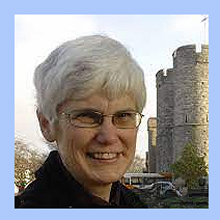
Sheila's talk was based on her research for a chapter about medieval migrants in a recently published book: ‘Kent and Europe, 1450 -1640’ Edited by Robert Blackmore, Craig Lambert.
She started by reminding us of Kent’s historic position as England’s Gateway County with short routes across the Channel to France and the Low Countries. Kent is actually a peninsular being bounded on three sides by the sea. In the 15th century the county had many established settlements along its coastline and maritime rivers; including fishing communities and the Cinque Ports. The tax records of the Cinque Ports show more migrants staying in Kent than in Sussex. In this era immigrants were arriving to live and work in England for economic reasons and not to escape religious persecution as was the case in the 16th century. In the 15th century the Channel was a Highway, not a Barrier, with migration an important but complicated pull and push, occurring in both directions. Sheila said she had not visited any foreign archives to study English migration to mainland Europe but it would be good to do so.
Canterbury was an important place for immigrants due to its location within the rich agrarian hinterland of East Kent, its status as a major ecclesiastical centre and its role as an international pilgrimage destination. But, however popular Canterbury was the city did not totally dominate as a place of residence for immigrants in this era. Records prove immigrants can be found living and working in many other places in Kent; such as Romney, Sandwich etc. and across the county up to Greenwich and Dartford. Many others used Kent as a stepping stone to London and some even went on to other parts of England.
Sheila then showed some statistics, although she advised us not to take these numbers on face value without explanation as there are several issues that skew them. She went on to outline issues. The first was that there are gaps in the records with years missing. Although, Kent, Canterbury and the Cinque Ports, often have more surviving records than London. Another issue was the spelling of foreign sounding Surnames. If the name was unfamiliar to the scribe he might just record what they thought he heard or a nationality or trade in place of a Surname; such as ‘Joan ‘Dutchwoman’ or ‘John Brewer’. But then in later years maybe another scribe who did understand would record the Surname correctly, giving a rise to the thought, are they one and the same or two different people? Immigrant married couples were listed independently in the records. But if a migrant woman married an English man she was no longer recorded in the records.
Sheila then introduced us to some of the immigrants she studied and said you could tell if the business was thriving year on year by the amount they had to pay in taxes each year. Some did not stay but would come for the day, such as the two women from the Low Countries who brought across beer they had brewed at home and having sold out in a day went back to mainland Europe. Beer Brewing spread across Kent impacting on Kent’s history as it was in competition with local Ale Brewers.
Goods were being importing to Sandwich in great numbers and immigrants organised warehouses to store the imports. Goods came not only from France and the Low Countries but also from Italy and other parts of the Mediterranean. The Italians imported Wode for dying cloth which attracted high taxes. Whilst the Venetians imported Wine, Spices Saffron and other luxury goods into the country.
Servanthood in this era was not like' upstairs and downstairs', immigrants servants most often were young relatives learning the business from an older relative before going into business themselves. Sheila said how some immigrants paid to become Freemen, such as in Canterbury, they would not have been able to carry on their trade in some paces had they not been freemen. Sheila said immigrants carried out a wide range of trades, Haberdashers, Cobblers, Hat makers, Tailors, Painters, Masons etc. In the latter part of the 15th century there was a depression after the country was hit by plague and wars. Many new rules and extra taxes were levied on immigrants. Plus curfews and restrictions on food they could sell.
Sheila ended by saying that walking through 15th century Canterbury you would hear a range of languages being spoken, which is very much like today.
About the Speaker: Dr Sheila Sweetinburgh began lecturing in mediaeval and early modern history at the University of Kent in 1995 and subsequently taught at Canterbury Christ Church University. She is a Trustee of the Wye Rural Museum Trust, which owns and runs Brook Rural Museum. Sheila is also on the Advisory Council for Kent Archaeological Society and Co-Director of the Centre for Kent History and Heritage; organising History Weekends, Study Days, Workshops, Conferences and Lectures. Sheila is currently working on a 3-year funded project on Kent's Maritime Communities.
Report by Tricia Baxter