
The date of this meeting was changed to a Monday as the church were using their hall on our usual second Friday. It was also our branch AGM and the AGM part of the evening was completed swiftly. After which we had a thoroughly interesting, informative but light-hearted talk by Imogen Corrigan, about why our ancestor’s travelled in the past.
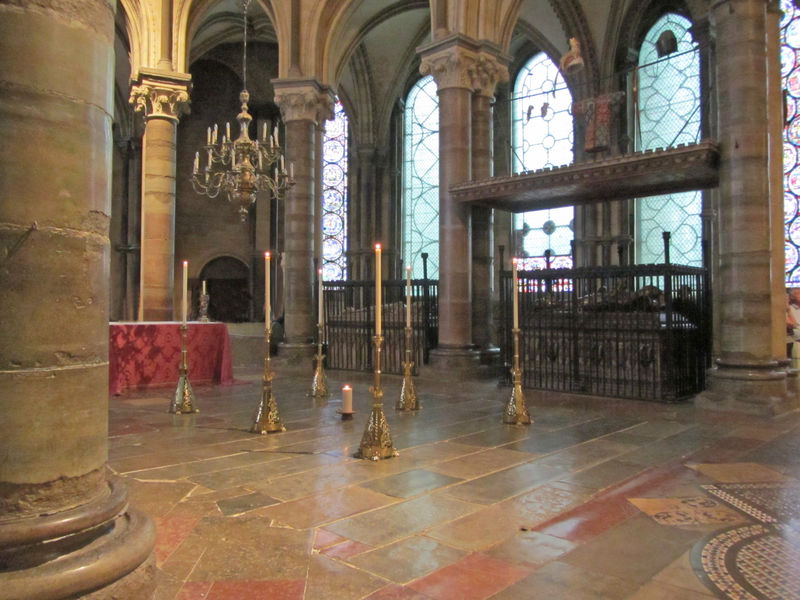
Trinity Chapel Canterbury Cathedral
Imogen said that in the Middle Ages many people never left their home village or went further than the nearest big town. But some did travel and to far distances too for several reasons, such as troop movement in time of war and merchants trading far and wide being high on the list. Kings progressed about their kingdoms both to be seen and to see to their affairs and Ambassadors to and from countries. But it was religious pilgrimages that put the most people on the road.
Imogen said that being Canterbury branch, we will be aware of the many pilgrims that made their way to our Cathedral in the past to visit the shrine of St Thomas Becket. His murder on the evening of 29th December 1170 was a most shocking event and Geoffrey Chaucer portrayed a group of stereotypical pilgrims travelling to the shrine of St Thomas of Canterbury in his book The Canterbury Tales. The miracles that followed the murder were most notable and the windows of Canterbury Cathedral are still telling the tales of the miracles to today’s tourists. Tourists being much like the pilgrims of yesteryear.
Undoubtedly, religious tourism was increased by the story of Becket. Although, people had been making pilgrimages for many centuries before Becket’s murder. The first truly English pilgrimage is considered to have been to the shrine of St Ecgbert an 8th century saint. But many pilgrims travelled the various routes to Rome whilst trying to pass as many shrines enroute as they could, such shrines as St Gregory, St Martin at Tours and St James at Santiago de Compostela. Many journeys were undertaken on foot and could be well over 1100 miles. So, what reason would they have to do that?
The top reason Imogen found was to be cured by praying at the site of holy relics and/or physically touching the coffin holding the remains of a saint. Also, it was the duty of mediaeval Catholics to do religious deeds such as visiting shrines, to get into heaven.
Like today travellers they needed a passport and Mediaeval passports were usually a letter written by the traveller’s parish priest or their local lord. Pilgrims usually travelled in groups for protection, carried a staff, and which is depicted in stained glass. They also wore pilgrim badges on their hats indicating that they were on a pilgrimage, and wore clothing that signified their purpose.
Several words have passed into our language over the years due to pilgrimages, such as: ‘Tourist’ from Tours in France which was a major place of pilgrimage and ‘Canter’ from Canterbury pace the stride or gait of a horse enroute to the shrine at Canterbury.
Report by Tricia Baxter - Canterbury Branch Hon. President