
Mary Smith, former head teacher of Maidstone Girl’s Grammar School [MGGS], gave members a fascinating glimpse of school life during WWII in her illustrated talk. This talk, which can be recommended for all age groups, was most engaging and many members reported back that they had enjoyed it.
In 2013, the school had two major discoveries which led to Mary being asked by her successor, the new Headteacher, if she would like to research the school in wartime for a commemorative book. This started Mary on a wonderful retirement pursuit.
The first discovery was when the route to the school’s WWII air raid shelter was cleared of rubble and found to be virtually intact. So much so, that it didn’t need much restoration to be usable as it once was. MGGS is now able to welcome parties of 21st century Primary School children to learn about life for school children in WW2, which is part of the current curriculum. Special lessons are held in a classroom in the school during which time the children learn what to do if an air raid siren sounds. Part way through the lesson the siren sounds and children are escort into the tunnels where the lesson is completed below ground. Some schools even have lunch in the shelters and eat the type of food that was on offer to school children 7/8 decades ago. Mary said that the 21st century children’s biggest concern was not going underground as you might think, but that they might be made to eat cabbage!
The second discovery was made whilst rummaging in an old cupboard on the school’s upper floor. Amongst several decades of papers was a dusty cardboard box in which was a very large thick book, the cover stating that it was the school’s War Diary 1939-1946. This ‘War Diary’ is a collection of pictures and sketches of everyday life in the school by the then Art Teacher Helen Keen. It is a wonderful source and has been shown to experts at the Imperial War Museum who said they do not know of anything like this artifact that gives so much information about school life during the war years 1939-46. Mary said virtually every school, in the forefront of aerial attack, had tunnels built as shelters in their grounds. But after the war many were filled in or dug up and no other school’s wartime shelters have been found to date.
During her research through various archives Mary tracked down and interviewed 53 'old' girls now in their 80s and 90s. A big event was hosted by MGGS for pupils and teachers past and present and most of the old girls attended. They were all invited to see the 'trenches' again but only 13 were able to manage the steep stairs in to the shelter. Mary showed a photo of those 13 old girls sitting on the benches in the shelter where they once sat over 8 decades ago during their wartime school days.
The War Diary starts with a picture dated September 1938 in which Helen Keen, the Art teacher depicted the brand-new school building with the hope, as one girl wrote, of “peace, happiness and sunshine”. This was short lived because of the unrest in Europe as they only had a year of peace before war broke out.
In the Summer of 1939, the eldest girls were called on to help with evacuees arriving in Maidstone. At the same time girls from King’s Warren School Plumstead were put on a train to Maidstone to share the school premises. The evacuees sat in the floor in a hall whilst foster parents chose which child they would foster. Those unfortunate not to be chosen were sent to a local children’s home. Mary said it seemed a strange decision to send so many evacuees to Maidstone as it was then a garrison town on a flight path from the coast to London. Mary showed photographs of the devastation from the many air raids that Maidstone suffered during the war. She said when some 2 years later an official from Plumstead came to see how the girl’s from King’s Warren were fairing, he noted how the town was being bombed and immediately arranged for the Plumstead girls to be moved to Bedford.
When war was finally declared the Headteacher sent letters to all the Parents telling them that their girls were not to come in to school until invited to do so. A postcard would be sent to let them know date and time to attend. Mary explained that it was because people were not allowed to congregate in large numbers for fear of enemy action. Hence, a small group of girls would be called into the school at any one time to receive Maths and English lessons and to take homework home to do until they were called in for the next session, which was often 3 weeks later. This system carried on, with the girls receiving little schooling, until February 1940 when construction of the air raid shelter had been completed and pupils could attend school again.
The Shelter was built by the workmen digging a trench lining the walls with concrete slabs and ceiling. Then earth was put back on top. The girls nick-named the shelter ‘trenches’ and were built in a zig-zag formation similar to the trenches of WWI. In the event of a direct hit the entire shelter would not be affected, as bomb blasts go in straight lines. Each zig and zag was big enough to seat a class of 30 girls and with all six classes in the shelter could hold 180 girls plus their teachers.
Mary said it would have been most difficult to teach in them as you needed to bellow to be heard especially as you could hear the noise of planes overhead and the thump, thump of bombs falling as the war continued above ground. But the teachers in the adjacent tunnels would also be teaching loudly too! Plus you could not see the entire class even when the first dim battery lanterns were replaced by electric lighting. Mary showed photos where even with modern brighter electric lights and the flash from her camera you could not see faces of those who sat back against the wall. Another difficulty was walking through the seated girls as their knees were almost touching. She learned from interviewing old girls that an order of “knees left” solved that. The trenches were also airless, cold and damp with puddles forming on the earth floor when it rained. They had bucket toilets but no heating. Hence during the winter, girls had to come with extra clothing to wear in case they had to go down into the shelters. This might be five times in one day or on other occasions they might be underground 6 or 7 hours at a time. The shelter’s walls were used as blackboards and the remains of lessons still adorn the walls today.
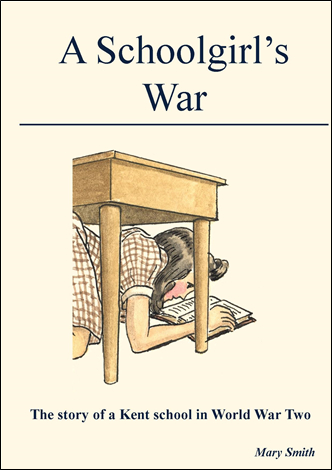
When Doodle-bugs attacks began there was no time to get the school into the shelter as when their engines cut out they immediately fell so the girls and their teachers had to shelter under their desks. They were told to ensure their head was under and not to worry about their bottoms. One old girl said she did her school certificate exam under her desk!
The Head Mistress was very strict, where other schools sang songs in their shelters she insisted her girls continued their lessons as normal as was possible in the shelters or under a desk. But Mary said she was not unfeeling as after raids she would find out where bombs had fallen and go out in her car with the register to check on the homes of her girls. She was concerned by what they might find and said she did not want any of her girls going back alone to find their home had been bombed.
The school had two shelters built one at the front of the building and one to the rear. The second shelter in the front of the school had been presumed filled in but they were discovered a few years ago and have been examined by experts and found to also be in a reasonable condition. Maidstone Girl’s Grammar School are hoping to have an open occasion in Spring of 2026 when adults will be invited to go into the shelters. When we have notice of the actual date of the event we will circulate it in the Society’s electronic Newsletter.
The book, ‘ A Schoolgirl’s War’, that resulted from Mary’s research would make an ideal Christmas gift. It is available from Mary.
About the speaker:
Mary Smith is a freelance journalist, author, lecturer, trainer and was the former headteacher of Maidstone Girls’ Grammar School.
Report by: Tricia Baxter